Certification Readiness

Our tailor-made management systems will get you certified the first time.

Speak to one of our experts about our Certification Readiness Guarantee today!

What Does ISO Certification Mean?

“ISO Certification” is the term commonly used to explain that your Business Management System is certified to one or more International Standards, also known as ISO Standards.

Businesses certified to ISO Management System Standards operate Business Management Systems which are recognised and valid all around the world.

Who Certifies your Business?

Even though most people say “ISO Certification”, ISO does not provide any kind of Certifications. All developed countries and most developing countries have Accreditation Bodies that are either part of governments or recognised by governments. In Australia and New Zealand, the governments established the Joint Accreditation System of Australia and New Zealand (JASANZ) for the accreditation of Conformity Assessment Bodies (CABs). The CABs are the entities that ultimately audit and certify organisations’ management systems, products or persons in their region, and elsewhere in the world.

What ISO Certification Experts Does

ISO Certification Experts provides consultancy services to get your business Certification Ready. We can assist you in creating management systems according to your business resources and requirements that will get you certified the first time.

What is ISO?

ISO (the International Organisation for Standardisation) is an independent, non-governmental organisation, based in Geneva, Switzerland.

ISO Standards are documents that provide requirements, specifications, guidelines or characteristics that can be used consistently to ensure that materials, products, processes and services are fit for their purpose.
Certification Readiness Guarantee Badge

Certification Readiness Guarantee

We are extremely passionate about delivering the most effective management solutions to each business. As a result, every business we have taken through our proven process has achieved Certification first time! Based on our proven framework and methodologies, we guarantee results.

Please note ISO Certification Experts is not an Accredited Conformity Assessment Body. We’re a consulting and training business, and we do not conduct Third Party Audits to achieve certification to the requirements of a specific ISO Management System standard. Our role is to assist you in achieving ISO Certification Readiness and Business Process Improvement. No single organisation is allowed to do both the consulting and the certification parts of your project, as this is a conflict of interest and not meeting the ISO governing rule requirements.

Do I need to be ready for ISO Certification?

Yes. Your business needs to meet all requirements of the ISO Management System Standard(s) you’re aiming to achieve Certification to, as relevant to your business operations.

Your business operations and your documented information need to meet the specific ISO Management System Standard(s) requirements.

It’s a good idea to purchase the ISO Management System Standard(s) documents as soon as possible, and review the requirements to gain an initial understanding of what you’re working towards. All ISO Standards are available for purchase from the Standards Australia store. (You’ll need to purchase the Standard(s) that you go for Certification to anyway, to have in your business Reference Library – the Certification Auditor will often check you have a correctly licensed version as part of the initial Certification Audit process).

I’ve reviewed the ISO Management System Standard(s) requirements. What now?

After you’ve reviewed the requirements, why not take advantage of our FREE 1 Hour Strategy Session to get clarity on the Certification Readiness process? This is your chance to get all your questions answered!

Certification Readiness process

Our approach to the Certification Readiness Process is broken down into 3 Phases. We can tailor our service for you depending on your needs. The infographic shows the steps of the entire process.
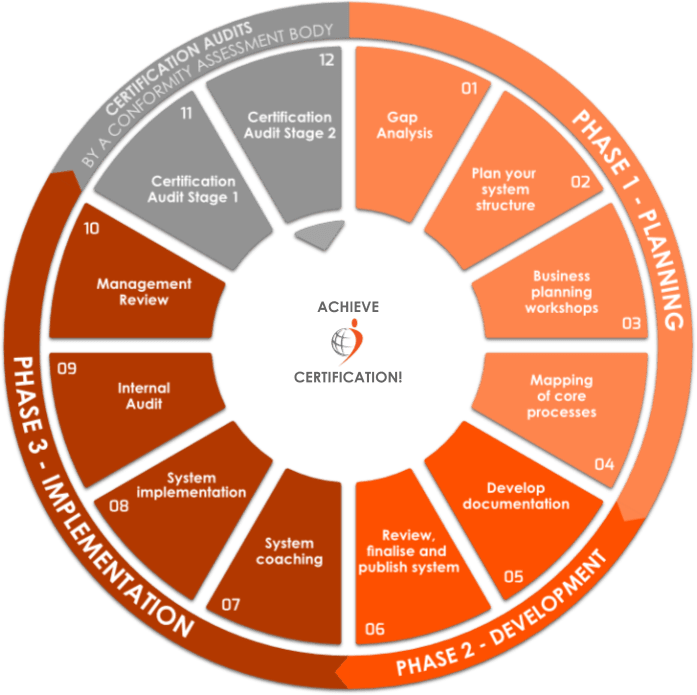
Wheel Diagram that represents different stages involved in ISO Certification Process

Get your FREE Certification Readiness Process Diagram today!

Get a Free Initial Assessment of
your Organisation’s Certification
Readiness via the Form Below

Get a Free Initial Assessment of
your Organisation’s Certification
Readiness

Frequently Asked Questions for Certification Readiness

A Management System is a framework of documented information – such as policies, processes, procedures, and templates – that defines how a business is managed and operated to achieve its goals and best practices. In practical terms, it isn’t just a set of rules; it is the day-to-day blueprint for how your business runs.

A Management System can be designed to conform to the specific requirements of one or more ISO Management System Standards (like ISO 9001 for Quality or ISO 45001 for Occupational Health & Safety).

In this context, creating and embedding this framework into your daily operations, a process called “implementation”, is the prerequisite to having an external certification body audit your business and award you an official ISO Certification.

ISO Certification readiness is being an organisation that demonstrates:

1. Disciplined Implementation: You have not just written policies and procedures; you have actually put them into practice across your business. The “day-to-day” operations of your company reflect the requirements of your own process and of the standard(s) you’re seeking certification against.

2. Operational Alignment: Your processes are not just “paperwork exercises” – they define how your business actually runs. Your staff are trained, they understand their roles, and they are actively following the documented processes.

3. Leadership Engagement: Leadership isn’t just “signing off” on documents; they are actively committed, defining roles, allocating necessary resources, setting objectives, and reviewing the performance of the management system.

4. Evidence of Use: You have concrete records (evidence) that the system is being used. This includes completed internal audits, documented management reviews, evidence of addressing non-conformities, and records of continuous improvement.

5. Sustainability: Your system isn’t a one-time project to “pass an audit.” A “ready” organisation is one that has built a culture where the management system is maintained, kept up-to-date, and improved upon over time.

The short answer is no. If your business has very few documented processes, policies, or formal structures in place, conducting an ISO Gap Analysis will be of little to no value to you. If you already know you are starting from zero, you don’t need a consultant to formally report that you have “gaps.” In this case, we would recommend skipping the gap analysis altogether and moving straight into designing and building a brand-new, customised Management System from the ground up.

When an ISO Gap Analysis is recommended and of value to you: If your business has been operating for a while and you already have existing procedures, manuals, templates, and workflows, a Gap Analysis is the best place to start. Instead of throwing away the work you’ve already done, the analysis compares your current operations against the specific requirements of the ISO Standard(s). This prevents you from “reinventing the wheel” and tells you exactly what needs to be adjusted, created, or improved to reach ISO Certification readiness.

Key insight: If you do proceed with a Gap Analysis, make sure it is not just a simple “tick-box” report that just lists which clauses you failed. A valuable Gap Analysis should provide a practical, detailed “to-do list” of required actions and recommendations on exactly how to address the missing elements.

If you are starting from scratch, it typically takes at least three to six months to get ready for certification. However, this is a baseline. The actual timeline is highly variable and depends on a few key factors:

Size and Complexity: A small, single-location business with straightforward processes will naturally take less time than a large, multi-site organisation with complex manufacturing or service delivery models.

Your Team’s Availability: Developing a Management System isn’t something a consultant can do entirely in isolation. It requires active involvement, feedback, and training from your leadership and staff. If your team is too busy with “business as usual” to review documents or attend training or workshops, the project will be delayed.

Effective Implementation: The goal isn’t just to write documents, but to actually use them. You will need to allow enough time for your team to adopt the new procedures and generate the necessary evidence (records) to prove the system is working before the Certification Audit.

A Warning on Timelines: Be careful of promises of “instant” or “one-week” certification – this is a major red flag! A timeframe that short usually means you are being handed generic, one-size-fits-all templates that haven’t been customised to your business, which often leads to audit failures and re-work required down the line.

If you want a more precise timeline for your specific situation, please reach out to us directly so we can assess the scope of your operations.

The short answer is no, you do not need specialised software to achieve ISO Certification. A Management System can be run effectively using standard business applications (like Microsoft Office or Google Workspace) and well-organised file storage.

While software can streamline the process, don’t treat it as a magic bullet. A promise of “instant software for certification readiness” is a red flag! There is no such thing. If you do decide to invest in specialised software, keep the following in mind:

1. It must be configured: Software needs to be tailored to your organisation’s terminology, processes, roles, and workflows. Buying a generic system and expecting it to instantly make you compliant won’t work.

2. Adoption is critical: A system that sits on the virtual shelf is a liability. Your team must be trained on the software and actually use it in their day-to-day operational roles to generate the records (evidence) an auditor will look for.

3. It doesn’t replace the work: Software is just a tool. The real work is developing the content, defining the processes, and driving the cultural change needed to run your business effectively and meet the requirements of the relevant ISO Standard(s).

Ultimately, investing in software only makes sense if your team will fully adopt it; otherwise, you absorb the cost without gaining the value.

The In-House Approach to ISO Certification Readiness:
If you decide to handle the project internally, you need to ensure that the team leading the project is highly experienced and knowledgeable about the specific ISO Standard(s) and the certification process. The Challenges to Consider:

  • Time and Disruption: If you do not have a dedicated, experienced full-time employee for this, your staff will need to fit this business improvement project around their “business as usual” roles. This can cause significant delays; an untrained internal team trying to figure it out on their own (or using generic “DIY templates”) can easily take 6 to 18 months. Also think about the opportunity cost of the time taken away from their core role in the business, which could impact delivery of your products and/or services to your customers.
  • Internal Bias: Internal teams are often attached to their own way of doing things. It can be difficult for an internal employee to objectively challenge old habits and identify areas for process improvement.
  • The Risk of “DIY Kits”: Be careful when purchasing “DIY ISO Kits” to save money on consulting. These generic templates lack contextual understanding of your business, and tailoring them properly still requires a deep understanding of ISO Management System Standard requirements.

The Consultant Approach to ISO Certification Readiness:
Engaging a professional ISO Consultant is positioned as a way to minimise risk, save time, and prevent costly audit failures.
The Benefits: Efficiency and Minimal Disruption: A consultant takes the heavy lifting off your staff’s shoulders, allowing your team to focus on their primary roles while the project moves forward smoothly.
Best Practice Solutions: Consultants bring knowledge of what has successfully worked for other businesses in your industry, offering a fresh, unbiased perspective that an internal team might miss.
Customisation: A good consultant will not hand you generic paperwork; they will build a bespoke Management System that actually reflects your unique business operations.

The Hybrid Option to ISO Certification Readiness:
It is also not necessarily an “all or nothing” choice. You can choose a level of support that suits your budget and capabilities. For example, you might have your internal team build the system, but hire an expert consultant purely to conduct your formal Internal Audit right before the official certification audit. This provides an unbiased final check of your system without paying for a full-scale management system development project.

To achieve ISO certification readiness, involvement is needed across multiple levels of your organisation:

  • Leadership (Top Management): Must actively drive the project, set objectives, allocate resources, and participate in system reviews.
  • Internal Lead: Ideally you have a dedicated project champion to coordinate efforts, understand current operations, and act as the main point of contact.
  • Operational Managers: Key personnel who help design and test the new procedures to ensure they are practical for day-to-day work.
  • General Staff: Employees must be trained on the new systems and actively use the procedures and templates in their daily tasks.
  • External Consultant (Optional): Can be brought in to guide the project, build a customised system, and run internal audits if your team lacks the time or expertise.

“Implementation” is the critical phase where your Integrated Management System (IMS) transitions from being just a collection of documents to a living, breathing part of your daily operations. Simply put: it is the process of actively putting your written policies, procedures, and workflows into practice. Here is exactly what is involved in a successful implementation phase:

  • Creating an Implementation Plan: Before rolling anything out, this involves developing a checklist or roadmap to guide your staff through the transition – covering everything from new induction processes to emergency drills and equipment maintenance schedules.
  • Training and Communication: You cannot implement a system in a vacuum. This step involves training your team on the new processes, ensuring they understand their specific roles, and communicating the updated policies (like Quality, Safety, or Environmental) across the organisation.
  • Generating Evidence (Using the System): This is the core of implementation. An auditor doesn’t just want to see a blank template; they want to see it used. This means actively filling out forms, logging data, and maintaining registers. Examples include completing site safety inspections, logging corrective actions, conducting performance reviews, and tracking equipment calibration.
  • Conducting Internal Audits: Once the system is running, you must formally assess it. Internal audits check whether your staff are actually following the new procedures and help identify any gaps or “non-conformities” that need fixing. Internal Audits are a mandatory requirement of all ISO Management System Standards.
  • Management Review: Leadership must actively review the performance of the IMS. This involves looking at the results of internal audits, evaluating risks, and making decisions to continually improve the system and the organisation’s operations.

Ultimately, implementation means integrating the IMS so deeply into your organisation that it simply becomes “business as usual.” If your team is treating the management system as an administrative burden separate from their actual jobs, it hasn’t been fully and effectively implemented yet.

Yes, you can, but it is not a simple “pass or fail.” Instead, auditors evaluate your system and issue findings based on the severity of any issues they uncover:

  • Minor Non-Conformances: Small, isolated gaps. You will still get certified, provided you submit an action plan to fix the issues.
  • Major Non-Conformances: A complete breakdown or absence of a critical process. This is the equivalent of “failing,” and your certification will be temporarily withheld.
    What happens if you get a Major Non-Conformance? It is not a dead end. The auditor will typically give you a set timeframe (usually 30 days) to fix the problem, and the root cause of the problem. Once they verify that you have resolved the issue, your certification can be officially awarded.

Prevention tip: Conducting a rigorous Internal Audit acts as a dress rehearsal to catch and fix major issues before the external auditor arrives.

Have a question we didn’t answer here? Visit our full FAQ page.