ISO/IEC 42001:2023
Artificial Intelligence Management Systems
Ready to lead your industry with responsible, secure, and trustworthy AI governance?
Book a FREE Strategy Session to discover how implementing ISO 42001:2023 can protect your business from algorithmic risks while opening doors to elite corporate contracts.
What is the ISO/IEC 42001:2023 Artificial Intelligence Management System Standard?
ISO/IEC 42001:2023 is the premier international standard specifically designed to govern Artificial Intelligence Management Systems (AIMS). Unlike traditional IT or information security frameworks, ISO 42001 addresses the distinct, dynamic challenges posed by machine learning, generative models, and automated decision-making. It provides organisations with a structured, repeatable methodology for designing, deploying, and overseeing AI technologies safely and responsibly.
Implementing ISO 42001 enables your business to manage complex AI risks, such as algorithmic bias, model hallucination, data provenance issues, and lack of system explainability. By embedding robust governance directly into your technology lifecycle, the standard protects your brand reputation, ensures human oversight, and aligns your operations with evolving global regulatory frameworks.
Note that the full official title of the standard is ISO/IEC 42001:2023, Information technology — Artificial intelligence — Management system.
ISO 42001 Standard Documents
The ISO/IEC 42001:2023 document was jointly developed by the International Organization for Standardization (ISO) and the International Electrotechnical Commission (IEC). It details the core context, leadership mandates, operational controls, and risk assessment methodologies required for an effective AIMS. We strongly advise purchasing an official licensed copy of the standard to ensure your internal teams understand its specific clauses. You can acquire a copy via Standards Australia.
The Benefits of ISO 42001 Artificial Intelligence Management Systems

Responsible AI and Ethical Governance
Implementing ISO 42001:2023 ensures your AI systems are developed and used ethically. By providing a structured framework that prioritises fairness, explainability, and accountability, the standard helps organisations mitigate algorithm bias and build trustworthy AI ecosystems that respect human rights and dignity.
Regulatory Readiness and Alignment
With artificial intelligence laws rapidly evolving worldwide, ISO 42001 provides a proactive framework to navigate the complex regulatory landscape. Adhering to this standard ensures your organisation meets regulatory obligations and aligns with international guidelines, reducing legal risks and future-proofing your AI investments.

Confidentiality and Integrity of Strengthened Data Security and Privacy
AI systems rely heavily on large, sensitive datasets. ISO 42001 works seamlessly with information security controls to ensure the protection, confidentiality, and integrity of the data powering your AI models.

Greater Control over AI Risks
ISO 42001 promotes a culture of iterative risk assessment tailored specifically to artificial intelligence. By implementing targeted mitigation strategies, such as AI impact assessments and regular monitoring, your organisation gains greater control over AI-specific vulnerabilities, ensuring reliable system performance and informed decision-making.

Lifecycle Management and Human Oversight
The standard requires that AI systems are monitored effectively from inception and model development through to deployment and eventual retirement. By mandating appropriate human-in-the-loop controls, it ensures automated systems remain safe, predictable, and aligned with your organisational objectives.
General Benefits of ISO Management System Standards

Qualify for Tenders, Contracts and International Trade
Large corporations and public sector agencies increasingly require suppliers to demonstrate strict governance over automated technologies. Achieving ISO 42001 certification acts as an immediate trust signal, giving your business a decisive advantage in competitive contracts and tendering processes.

Improve Brand Reputation and Stakeholder Confidence
Demonstrating independent verification of your ethical technology practices builds incredible brand equity. Investors, clients, and partners can operate with complete confidence, knowing that your organisation prioritises responsible innovation, data privacy, and ethical technology standards.

Improve Business Planning and Align with Strategy
The structured, risk-based approach of ISO 42001 encourages businesses to align their AI objectives with broader organisational goals. By integrating AI governance into strategic planning, the standard supports better decision-making, reduces uncertainty, and ensures that resources are directed toward high-priority technological advancements.

Higher Profit & Reduced Costs via Improved Efficiencies
ISO 42001 promotes operational efficiency by streamlining AI development processes, reducing redundancies, and lowering the likelihood of costly incidents such as algorithmic errors or the requirement for project rework. These improvements minimise financial risk and contribute to leaner operations, leading to higher profit margins.

Improve Business Structure for Sustainable Growth
Implementing ISO 42001 helps establish a consistent and well-documented approach to managing AI across all areas of the organisation. This standardisation supports a more robust business structure, clearer roles and responsibilities, and better scalability. As a result, the organisation is better positioned to grow sustainably while maintaining strict operational control.
Are you ready for Certification to ISO 42001?
Want to know how close your business is to being ready for Certification to ISO 42001:2023? Download our quick checklist to help you understand the key requirements of the standard. For a customised quote, send your completed checklist to [email protected] and our team will get in touch with you.

ISO 42001 Certification Process: Step-by-Step Guide
Achieving ISO 42001 certification demonstrates that your organisation has implemented an effective Artificial Intelligence Management System. Our experienced team guides you through every step of the journey:
01
Planning
Understanding the requirements of the ISO 42001 standard is crucial. Unless starting from scratch, this phase entails performing a gap analysis to assess the current state of the organisation’s AI practices and documentation in relation to the ISO 42001 requirements. A strategy will then be created to tackle these gaps and establish a clear path for implementation.
02
Documentation & Development
During this stage, an Artificial Intelligence Management System (AIMS) must be developed by creating the necessary documentation, including AI policies, ethical guidelines, AI impact assessments, and system lifecycle processes. This is where our consultants’ expertise comes into play, helping you save money and time by tackling this strategically.
03
Implementation
The ISO 42001 AIMS is implemented and embedded across the organisation, ensuring staff understand the AI policies, processes and their individual responsibilities. Implementation involves consistently applying documented controls across data management, model development, and deployment, monitoring performance, and tracking AI-related activities to manage risks effectively.
04
Management Review & Internal Audit
An internal audit, as required by ISO 42001, assesses how well your AIMS meets your own organisation’s requirements and the standard’s requirements, and identifies any gaps or opportunities for improvement. Management Reviews evaluate the AIMS performance, including results from audits, AI incidents, risk assessments, and bias metrics. These reviews help determine whether the system remains trustworthy, relevant, and aligned with business objectives.
05
External Audits
At this step, you need to engage a Certification Body (Conformity Assessment Body). They are the accredited organisations that will conduct the Certification (External) Audits to assess your organisation’s AIMS against the ISO 42001 requirements. Auditors will evaluate the management system’s effectiveness and its ability to deliver responsible AI outcomes. Upon successful completion, your organisation will receive your ISO 42001 Certificate.
06
Continual Improvement
Once certification is achieved, it’s valid for 3 years, and your Certification Body will return to conduct annual surveillance audits to ensure your business maintains its commitment to AI management. Ongoing activities are required by your organisation to ensure your AIMS still meets the requirements of the ISO 42001 Standard, and evidence of these will be checked by your auditor.
The Certification Readiness Journey for ISO 42001
The Certification Readiness Process is broken down into 3 Phases. We can tailor our service for you depending on your needs. The infographic shows the steps of the entire process.
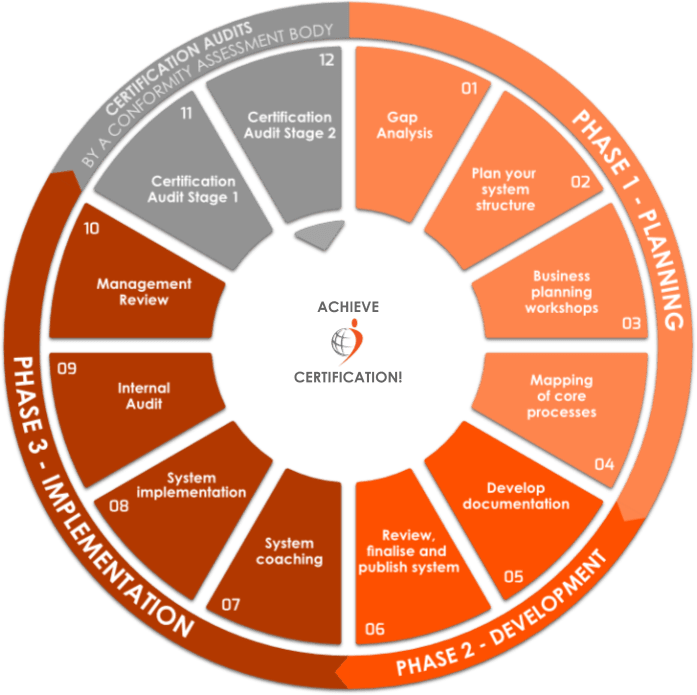
Get your FREE Certification Readiness Process Diagram today!
What Our Clients Have to Say
Discover how we’ve helped organisations like yours achieve their certification goals. Read our clients’ testimonials and Google reviews to learn about their experiences and the value we’ve delivered.


Why ISO 42001?
As artificial intelligence transforms everyday business operations, traditional IT and information security frameworks are no longer sufficient to address AI-specific challenges. Technologies like machine learning, deep neural networks, and generative AI introduce unique operational risks that standard risk frameworks fail to evaluate, such as model drift, algorithmic bias, and lack of output explainability.
Implementing ISO 42001 establishes a formal governance strategy that allows your enterprise to innovate rapidly without exposing the business to operational or reputational harm. Beyond risk mitigation, it creates a powerful commercial advantage: enterprise buyers and government bodies increasingly require suppliers to prove that their automated tools operate safely, transparently, and ethically before awarding high-value contracts.
ISO 42001 Overview: Understanding the Key Requirements and Clauses
ISO/IEC 42001:2023 uses the harmonised structure common to modern management system standards, allowing seamless integration with standards like ISO 27001 and ISO 9001. The core requirements are divided into primary management clauses (Clauses 4-10) and AI-specific controls (Annex A).
Visit Standards Australia to acquire a licensed version of the ISO standard, to read the requirements of each clause in more detail.

Climate Change Amendments to the ISO Standards
In February 2024, ISO announced a publication of Climate Action Amendments to existing and new ISO Management Systems Standards (MSS) to reflect ISO’s Climate Action commitments. This affects the main ISO Standards, including ISO 9001, ISO 27001, ISO 45001, and ISO 14001, among others. Click here to read more about this Climate Change Addition to the ISO Management System Standards.
How We Can Assist You
Our services are customisable for each business, depending on your specific needs.
Certification Readiness
Consulting Services that aid in preparing your business for Certification. This includes creating a unique management system that meets the specific needs of your business and satisfies the ISO/IEC 42001 Standard requirements, ensuring you successfully achieve Certification first-time.
Certification Ongoing Support
Assistance with meeting the ongoing requirements of your Information Security Management System. Saving you time and hassle, we manage your Internal Audit program and the other activities required by the ISO/IEC 42001 Standard annually.
Auditing
Our Internal Audit services provide a systematic and independent assessment of your Information Security Management System to determine its effectiveness and identify opportunities for improvement, ensuring the requirements of ISO 42001 are met. We also offer second party audit services.
ISO Gap Analysis
A Gap Analysis evaluates your current Management System against your target ISO standards to pinpoint exact gaps. It provides a clear roadmap to certification readiness, saving time and resources by focusing on what needs to be addressed.
Who Needs ISO 42001?
ISO 42001 is designed for any organisation that develops, deploys, or utilises artificial intelligence technologies within its operational landscape, regardless of size, sector, or technical maturity. Whether your organisation builds proprietary machine learning models, integrates third-party AI tools into customer platforms, or leverages generative AI to automate internal business decisions, the standard provides a scalable framework suited to your specific risk profile. As automated systems become deeply embedded into everyday workflows, having a structured governance framework ensures that technology adoption occurs safely without exposing your organisation to operational liabilities.
For software developers, SaaS providers, and technology vendors, achieving ISO 42001 certification delivers a distinct commercial advantage. It reassures corporate buyers and public sector procurement panels that your algorithms are safely engineered, transparently audited, and free from critical data privacy or ethical flaws. Simultaneously, for enterprise deployers and service integrators using automated decision-making, such as in financial services, healthcare, or human resources, the standard protects your brand reputation by establishing rigorous oversight, mitigating bias, and preventing high-profile algorithmic failures.
As stakeholder expectations shift and international regulatory guidelines evolve, demonstrating responsible technology management is transitioning from a competitive differentiator to an essential business practice. Organisations seeking to build long-term trust, secure enterprise-level contracts, and protect their operations against the dynamic risks of machine learning will find ISO 42001 to be a vital operational pillar for sustainable, technology-driven growth.
ISO 42001 Standards Across Key Industries
At ISO Certification Experts, our qualified expert consultants deliver tailored Artificial Intelligence Management System (AIMS) solutions to promote responsible AI deployment, manage AI-related risks, and meet evolving regulatory requirements across various sectors, including IT, finance, government, healthcare, legal, and professional services.
While artificial intelligence impacts every sector, ISO 42001 delivers immediate strategic value to high-reliance industries:
ISO 42001 for Technology & SaaS
Technology and SaaS companies depend heavily on complex algorithms and generative tools. ISO 42001 provides a risk-based approach to governing AI systems, helping organisations eliminate algorithmic defects, meet global regulatory standards, and build client trust in a fast-moving market.
ISO 42001 for Financial Services & FinTech
Financial institutions rely on automated credit scoring and machine learning models for critical decisions. ISO 42001 offers a structured framework for managing AI risk, helping organisations reduce model bias, fulfill regulatory obligations, and protect customer assets.
ISO 42001 for Healthcare & Life Sciences
Healthcare organisations increasingly harness AI for clinical diagnostics and data analysis. ISO 42001 delivers a systematic strategy for managing technology risks, helping providers safeguard patient data, align with health sector standards, and maintain vital human oversight.
ISO 42001 for Retail & E-Commerce
Modern retail brands leverage dynamic algorithms and personal recommendation engines. ISO 42001 provides a practical framework to oversee automated processes, preventing algorithmic errors, meeting data governance expectations, and strengthening consumer trust.
ISO 42001 for Professional & Business Services
Professional service firms frequently deploy artificial intelligence agents to streamline document review and client workflows. ISO 42001 delivers clear operational governance, helping firms eliminate shadow AI, maintain legal confidentiality obligations, and build long-term client trust.
ISO 42001 for Government & Public Sector Contractors
Public sector contractors must demonstrate that their automated tools operate ethically and transparently. ISO 42001 offers an auditable framework to mitigate automated bias, fulfill government procurement mandates, and build public confidence in digital services.
Get a Free Initial Assessment of
your Organisation’s Certification
Readiness via the Form Below

Why Choose ISO Certification Experts for ISO 42001 AI
Since 2007, ISO Certification Experts has delivered nearly two decades of industry-leading guidance, building a strong track record of helping organisations achieve their certification goals.
We cut through complexity to provide practical, result-driven solutions that fit naturally into your daily technical operations and workflows. Leveraging our broad experience across all primary ISO management frameworks, we ensure your artificial intelligence management system aligns smoothly with your existing structures, delivering true operational value without adding unnecessary friction.
Whether you are an emerging tech startup or an established enterprise, we tailor our approach to support your specific strategic vision. Consider our team a direct extension of yours, committed to making your ISO 42001 certification journey clear, efficient, and successful at every stage.
Featured Case Studies and Real-World Success Stories
Read our client testimonials, featuring some of Australia’s most reputable companies showcasing how ISO Certification Experts have helped businesses achieve and maintain certification.


Some of Our Clients








Start Your Journey with ISO Certification Experts
Book a FREE Strategy Session with us to discuss the best approach for your business, understand the benefits for your organisation, and find out how we can best help you achieve your goals!
Frequently Asked Questions about ISO 42001
Have a question we didn’t answer here? Visit our full FAQ page.