ISO 45001:2018
Occupational Health & Safety Management Systems
Does your business need assistance achieving or maintaining ISO 45001:2018 Certification to win your next big contract and drive growth?
Book a FREE Strategy Session with our Management System Consultants to discuss the best solution for achieving your certification goals.
What is the ISO 45001:2018 Occupational Health and Safety Management System Standard?
The ISO 45001:2018 Occupational Health and Safety (OHS) Management System Standard provides a framework for managing and preventing work-related injury and illness by identifying risks and opportunities to eliminate hazards and minimise risks, including system deficiencies. Also commonly known as Works Health and Safety (WHS), this international workplace safety standard assists organisations of any size, type, or industry in taking effective preventative actions to promote a safe and healthy workplace, while also effectively helping businesses with addressing legal and ethical concerns.
Various factors can contribute to the hazards and risks associated with poor working conditions, such as: governance gaps, failure to comply with the law, insufficient resources, scarce knowledge, unsustainable business practices, and the lack of a culture of prevention, just to name a few. Effective implementation of the ISO 45001:2018 Standard should provide a systematic approach to enable organisations to address and manage these OHS risks, and improve their ethical and safety reputation among customers, employees, and other stakeholders.

ISO 45001 Standard Documents
The ISO 45001:2018 Standard is an actual document developed by the International Organisation for Standardisation (ISO) detailing the standard’s clauses and requirements. We recommend that your business purchases a copy of the ISO 45001:2018 Standard document, to fully understand the requirements for successful implementation. Visit Standards Australia to purchase a copy.
The Benefits of ISO 45001 Occupational Health and Safety Management Systems

Safer and Healthier Workplace
ISO 45001:2018 establishes a comprehensive framework for managing workplace health and safety. It empowers businesses to create a proactive culture focused on reducing risks and preventing accidents, ensuring the health and well-being of employees. This structured approach leads to fewer workplace injuries, safer working conditions, and a healthier workforce.

Hazard Identification and Control
The ISO 45001 emphasises identification, evaluation, and control of potential hazards. With a systematic risk assessment process, businesses can address unsafe conditions before they lead to incidents, ensuring that appropriate control measures are put in place, and supports a culture of safety in the organisation.

Employee Satisfaction and Safety
Implementing ISO 45001 fosters a safe and supportive work environment where employees feel valued and protected. By prioritising health and safety, businesses improve employee morale, reduce stress, and build trust. This leads to increased employee satisfaction, enhanced engagement, and a greater sense of security at work, which can contribute to higher retention and productivity.

Productivity with Fewer Incidents and Downtime
By reducing workplace accidents and health-related issues, ISO 45001:2018 Occupational Health and Safety contributes to less downtime and fewer disruptions. With fewer incidents, businesses experience less unplanned downtime, lower absenteeism, and minimal operational disruptions.
Greater Management of Health and Safety Risks
ISO 45001:2018 provides businesses with a structured approach to managing health and safety risks through comprehensive risk assessments, monitoring, and mitigation strategies. By integrating regular reviews and continuous improvement, companies can effectively manage and reduce safety risks, ensuring compliance with regulations and enhancing overall safety performance.

General Benefits of ISO Management System Standards

Qualify for Tenders, Contracts and International Trade
Certification to ISO 45001:2018 reflects your commitment to global best-practice health and safety management. It enhances your organisation’s reputation and trust with stakeholders. This can open doors to new markets and business growth, while also meeting tender requirements, including for large and international contracts.

Improve Brand Reputation and Stakeholder Confidence
Certification to ISO 45001 is a confirmation to the stakeholders that your organisation meets globally recognised work and safety standards, enhancing your brand credibility and professional image. This builds greater trust with clients, investors, partners, and regulators.

Improve Business Planning and Align With Strategy
Promoting a structured, process-based approach to safety management, which supports better strategic planning and decision-making. With clearly WHS defined objectives, performance metrics, and risk controls, businesses can align their operations with their long-term vision and drive consistent improvements across all departments.

Higher Profit & Reduced Costs via Improved Efficiencies
You’ll typically benefit from streamlined processes, reduced incidents, and fewer errors or disruptions. By identifying inefficiencies and addressing operational risks early, businesses can cut costs, reduce fines and injury claims, improve resource use, and boost productivity.

Improve Business Structure for Sustainable Growth
This leads to the standardisation of WHS procedures and documentation, which strengthens internal systems and promotes consistency across teams. This foundation supports scalable growth, enabling your business to expand confidently while maintaining safety and performance.
Are you ready for Certification to ISO 45001?
Wondering what’s required to achieve Certification to ISO 45001:2018? Download our quick checklist to gain a clearer understanding of the main requirements. Once you’ve completed it, simply send it to us at [email protected], and our expert team will provide a customised quote and guide you through the next steps.

ISO 45001 Certification Process: Step-by-Step Guide
Achieving Certification to ISO 45001:2018 signifies that an organisation has successfully demonstrated its commitment to robust Occupational Health and Safety Management. The journey to achieve certification includes the following steps:
01
Planning
& Gap Analysis
Comprehending the standard ISO 45001requirements is vital. Planning may also entail conducting a Gap Analysis to grasp the current state of the organisation’s documentation against the ISO 45001 requirements, unless beginning fresh. Subsequently, a strategy is developed to address these gaps and create a structured path for the certification process.
02
Documentation & OHS Development
In this phase, documentation must be developed to form an Occupational Health & Safety Management System (OHSMS), including OHS policies, risk assessment procedures, work instructions, emergency plans and business planning documentation. This is the point where the knowledge in comprehending and implementing the Standard requirements comes into play, and expert consultants help you save money and time by strategically addressing these tasks.
03
Implementation, Training & Coaching
The implementation of the OHS (also known as WHS) Management System is extended throughout the entire organisation, and proper guidance for employees to understand the documentation and their respective duties is key at this stage. Implementation involves integrating the documented processes into everyday operations, regularly overseeing activities to ensure they are followed correctly, and collecting evidence and data to evaluate performance and effectiveness.
04
Management Review & Internal Audit
An internal audit, as required by ISO 45001:2018, evaluates how well your OHS Management System meets the standard’s requirements and identifies any gaps or areas for improvement. Management Reviews, also mandated by the standard, assess performance data and the overall effectiveness of the OHSMS to ensure it remains suitable, adequate, and aligned with the organisation’s health and safety objectives. This process supports informed decision-making, prioritises corrective actions, and promotes continual improvement in workplace safety.
05
External Audits & Certification
During this step, you need to engage a Certification Body (aka Conformity Assessment Bodies). These accredited organisations will conduct the Certification (External) Audits to evaluate your organisation’s OHSMS against the ISO 45001 requirements. Auditors will assess the management system’s effectiveness, its conformance with ISO 45001 standards, and its capacity to deliver reliable outcomes. Following a successful completion of the Certification Audit, your organisation will receive the ISO 45001 Certification. Find out how to select the right Certification Body for your business.
06
Continual Improvement
Once Certification to ISO 45001 is achieved, it’s valid for 3 years. Over this time, your Certification Body will return to conduct annual surveillance audits to verify your business ongoing commitment to its OHS management. Ongoing activities are required by your organisation to be regularly conducted, ensuring your OHSMS continues to meet the requirements of the ISO 45001 standard, and your Certification Body auditor will check evidence of this. Find out more about certification ongoing support.
The Certification Readiness Journey for ISO 45001
The Certification Readiness Process is broken down into 3 Phases. We can tailor our service for you depending on your needs. The infographic shows the steps of the entire process.
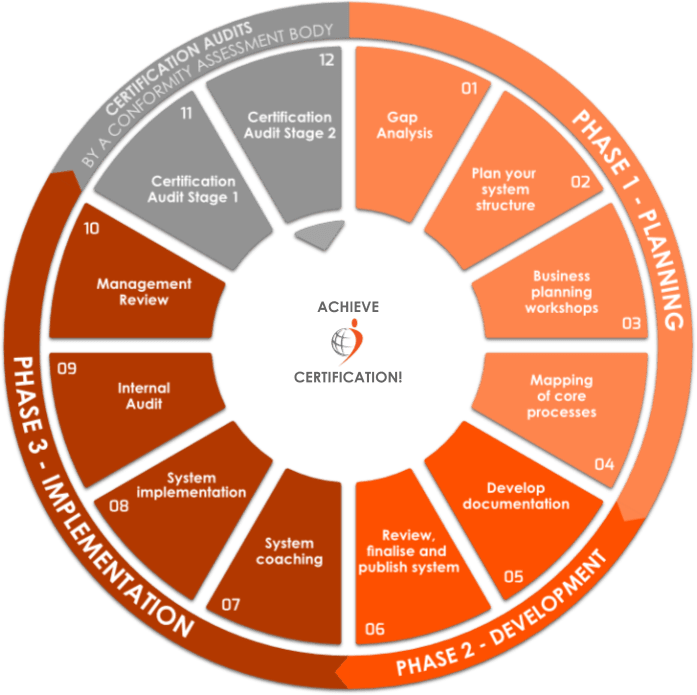
Get your FREE Certification Readiness Process Diagram today!
What Our Clients Have to Say
Discover how we’ve helped organisations like yours achieve their certification goals. Read our clients’ testimonials and Google reviews to learn about their experiences and the value we’ve delivered.


Why ISO 45001?
Achieving Certification to ISO 45001:2018 is a crucial measure for organisations of all sizes towards enhancing workplace health and safety, as well as overall business performance. ISO 45001 is an internationally recognised Occupational Health and Safety Management System (OHSMS), providing organisations with a globally respected standard to demonstrate their commitment to employee welfare and risk reduction.
Organisations that hold an ISO 45001 Certification showcase their dedication to maintaining a safe and healthy work environment, fostering trust among stakeholders, clients, and potential partners. Furthermore, it demonstrates commitment to upholding industry best practices and compliance, enhancing business reputation and competitiveness in the market.
In fact, achieving Certification to ISO 45001 can serve as a significant competitive advantage. It not only helps expand your market potential by qualifying your business for more lucrative projects, such as government tenders and grants, but it can also aid in fulfilling other contract or product requirements, and be used to lower insurance premiums.
The ISO 45001 safety standard serves as a powerful business safety improvement tool, enabling organisations to identify and address potential hazards, minimising workplace accidents and incidents, and boosting operational efficiency. This systematic approach to OHSMS implementation not only reduces workplace injuries and illnesses, but also results in increased productivity and reduced downtime.
ISO 45001 Overview: Understanding the Key Requirements and Clauses
Below is a short overview of the ISO 45001:2018 Occupational Health and Safety Management System standard, which is organised into ten clauses to enhance workplace safety standards. Clauses 4 to 10 outline the key requirements for establishing, implementing, and maintaining an effective Occupational Health and Safety Management System (OHSMS).
Visit Standards Australia to purchase a licensed copy of the full standard, to read the requirements of each clause in more detail.

Climate Change Amendments to the ISO Standards
In February 2024, ISO announced a publication of Climate Action Amendments to existing and new ISO Management Systems Standards (MSS) to reflect ISO’s Climate Action commitments. This affects the main ISO Standards, including ISO 9001, ISO 27001, ISO 45001, and ISO 14001, among others. Click here to read more about this Climate Change Addition to the ISO Management System Standards.
How We Can Assist You
Our services are customisable for each business, depending on your specific needs.
Certification Readiness
Consulting Services to help your business get ready for Certification, including provision of a bespoke management system to suit each individual business, and meet the ISO 9001:2015 Standard requirements, ensuring you get Certified the first time.
Certification Ongoing Support
Support and guidance with meeting the ongoing requirements of your Quality Management System. We manage your Internal Audit program and other activities required annually to ensure continued conformance with the ISO 9001:2015 Standard.
Auditing
Our Internal Audit services offer a systematic and independent assessment of your Quality Management System to determine its effectiveness and facilitate continual improvement, ensuring the ISO 9001:2015 requirements are met. We also provide Second Party Audit services.
ISO Gap Analysis
A Gap Analysis evaluates your current Management System against your target ISO standards to pinpoint exact gaps. It provides a clear roadmap to certification readiness, saving time and resources by focusing on what needs to be addressed.
Who Needs ISO 45001 Certification?
ISO 45001:2018 Standard is designed for organisations of all sizes and industries that are committed to ensuring the health, safety, and well-being of their employees and stakeholders. Any business, whether it operates in high-risk sectors such as construction, manufacturing, or transportation, or in low-risk sectors like offices or retail, can pursue the safety standard, and reap its benefits.
The standard is designed to be generic and flexible, meaning that the requirements can be adapted to any industry, regardless of scope or size. The process of implementing the requirements of an ISO 45001 is very similar regardless of the size of your business; it will be adapted to the scale, complexities and needs of each organisation and industry.
We’ve helped over 200 client organisations achieve and maintain certification to ISO standards, including ISO 45001, across a range of different industries and sized enterprises. Want to check if ISO 45001 is the right fit for your business? Book a FREE Strategy Session with our ISO 45001 consultants today.
ISO 45001 Standards Across Key Industries
At ISO Certification Experts, we bring extensive expertise and consultancy in implementing ISO 45001 Occupational Health and Safety Management Systems across critical industries such as manufacturing, construction, healthcare, energy, and transportation. Our expert ISO 45001 consultants provide tailored solutions to help your organisation achieve certification and foster a safer and healthier workplace.
Discover the industries we’ve successfully supported with consulting services to ISO 45001 below.
ISO 45001 for Construction
The construction industry is one of the highest-risk sectors, with common hazards including falls from heights, heavy machinery accidents, and electrical risks. Implementing ISO 45001 ensures you implement controls such as strict risk assessments, site safety planning, and mandatory worker training. Organisations must also focus on contractor safety management and emergency preparedness to reduce workplace injuries and meet safety regulations.
ISO 45001 for Healthcare
In healthcare, workers face risks such as biological hazards, patient handling injuries, and exposure to hazardous substances. ISO 45001 strengthens workplace safety by implementing infection control measures, safe patient handling protocols, and mental health support programs. Hospitals and healthcare facilities must also ensure emergency response preparedness and compliance with healthcare-specific safety regulations.
ISO 45001 for Professional Services
Though lower-risk, office environments still face WHS issues, including work-related stress, ergonomic issues, and fire hazards. ISO 45001:2018 certification enhances safety by promoting ergonomic workstation setups, mental health awareness programs, and clear emergency and evacuation procedures.
ISO 45001 for Retail & Hospitality
Retail and hospitality workers can deal with customer interactions, slip and trip hazards, and workplace violence risks. ISO 45001helps businesses improve areas like store layout safety, establish injury reporting systems, and train employees on conflict resolution. Effective safety policies also ensure compliance with local occupational health regulations, reducing liability risks.
ISO 45001 for Manufacturing
Manufacturing workplaces can expose employees to hazardous machinery, repetitive strain injuries, and exposure to chemicals. ISO 45001:2018 helps mitigate these risks with controls such as enforcing proper machine guarding, personal protective equipment policies, and workplace ergonomics programs. Manufacturers must also prioritise regular equipment maintenance and hazard identification to prevent accidents and improve efficiency.
ISO 45001 for Transport & Logistics
Employees in transport and logistics face risks related to vehicular accidents, manual handling injuries, and exposure to hazardous cargo. Implementing ISO 45001 supports the introduction of safety measures like strict driver training, fatigue management programs, and compliance with road safety regulations. Businesses must also focus on ergonomic lifting techniques and warehouse hazard identification to prevent injuries.
ISO 45001 for Mining
Mining is one of the most hazardous industries, with risks such as explosions, cave-ins, and exposure to toxic gases. ISO 45001OHSMS enhances safety by requiring regular risk assessments, proper ventilation systems, and strict PPE requirements. Companies must also establish comprehensive emergency response plans and routine equipment safety checks to protect workers in high-risk environments.
ISO 45001 for Agriculture & Farming
Agricultural workers face equipment-related injuries, pesticide exposure, and extreme weather conditions. ISO 45001:2018 certification promotes safe equipment handling, chemical safety training, and heat stress prevention programs. Farms and agribusinesses must also prioritise vehicle safety and employee training on handling livestock-related hazards.
History of ISO 45001
ISO technical committees perform evaluations of all ISO Standards roughly every five years. If a standard is modified and improved due to such an evaluation, a new edition of the standard will be issued by ISO, with the new title indicating the year in which the revision occurred.
While the first and still current version of ISO 45001 was published in 2018. Until recently, and before ISO 45001 was published, there were other WHS standards previously available for businesses to get Certified to, which are all now superseded by ISO 45001:2018. Here is a brief history of the ISO 45001 Occupational Health and Safety Management System Standard:
OHSAS 18001:2007
Withdrawn
First published in 1999, OHSAS 18001 provided a framework for organisations to manage their OH&S risks and ensure compliance with relevant laws and regulations. While it wasn’t an official ISO Standard, OHSAS 18001 was superseded at the end of 2021 by ISO 45001:2018.
AS/NZS 4801:2001
Withdrawn
AS/NZS 4801 is an Australian and New Zealand standard for OH&S Management Systems. It provides a framework for organisations to manage their occupational health and safety risks, and improve the safety and well-being of employees. AS/NZS 4801:2001 was superseded by ISO 45001:2018 in July 2023.
ISO 45001:2018
Current Version
Published for the first time in 2018, ISO 45001 was created to provide a more comprehensive and globally recognised standard for occupational health and safety management. Prior to its creation, different countries had their own standards and regulations for OH&S management, which made it difficult for organisations operating across borders to ensure compliance with all the relevant requirements.
ISO 45001:2027
Draft
This is the next version which is due for publication during 2027. Find out more about the upcoming new version of the ISO 45001 standard here.
Get a Free Initial Assessment of
your Organisation’s Certification
Readiness via the Form Below

Why Choose ISO Certification Experts For ISO 45001 Safety
Founded in 2007, ISO Certification Experts offers over 18 years of specialised management consulting experience, earning a strong reputation for guiding clients to success in their ISO 45001 and certification journey.
We prioritise clarity, practicality, and valuable results, delivering customised solutions that fit naturally into your everyday business processes. With extensive knowledge across all major ISO Management System Standards, we stand out for our ability to make certification both meaningful and achievable.
From small businesses to large enterprises across diverse industries, we’re here to help you reach your strategic objectives. Consider us your reliable certification partner, dedicated to making the process straightforward, stress-free, and fully aligned with your goals.
Featured Case Studies and Real-World Success Stories
Read our client testimonials, featuring some of Australia’s most reputable companies showcasing how ISO Certification Experts have helped businesses achieve and maintain certification.




Some of Our Clients











Start Your Journey with ISO Certification Experts
Book a FREE Strategy Session with us to discuss the best approach for your business, understand the benefits for your organisation, and find out how we can best help you achieve your goals!
Frequently Asked Questions about ISO 45001
Have a question we didn’t answer here? Visit our full FAQ page.