ISO 14001:2026
Environmental Management Systems
Do you need assistance with achieving and maintaining Certification to the ISO 14001:2026 Standard?
Book a FREE Strategy Session with our Management System Consultants to discuss the best solution for achieving your certification goals.
What is the ISO 14001:2026 Environmental Management System Standard?
ISO 14001:2026 Environmental Management System Standard is an internationally-recognised framework to facilitate continual improvement for better managing business environmental responsibilities in a systematic and proactive way, with the goal of reducing its environmental impacts.
In other words, ISO 14001:2026 helps organisations to manage and improve their environmental performance throughout the entire life cycle of their activities, services and/or products. This is achieved by identifying and controlling impact, reducing resource consumption and waste, and promoting sustainable practices in operations in relation to how the organisation interacts with the environment.
The standard is designed to help organisations of all sizes and industries to minimise their environmental footprint and demonstrate their commitment to sustainability.

ISO 14001 Standard Documents
The ISO 14001:2026 Standard is an actual document developed by the International Organisation for Standardisation (ISO) detailing the standard’s clauses and requirements. We highly recommend that you purchase the ISO 14001:2026 Standard document, to fully understand the requirements for successful implementation.
Benefits of ISO 14001:2026 Environmental Management Systems

Reduce Environmental Impact
ISO 14001 helps businesses implement systematic approaches to reduce their environmental footprint. By identifying inefficiencies and streamlining processes, organisations can minimise waste, lower energy consumption, and reduce carbon emissions.

Improve Business Sustainability
By adopting ISO 14001, you’ll optimise the use of natural resources, reducing waste, and improving the overall efficiency of your operations. It supports long-term environmental responsibility, helps meet regulatory requirements, and enhances reputation, ultimately contributing to more resilient, sustainable business operations.

Positively Impact the Environment
ISO 14001:2026 provides a comprehensive framework that allows businesses to identify environmental aspects and impacts. Identifying and assessing these aspects such as energy use, waste production, water consumption, and emissions, businesses can pinpoint where they can make the most difference.

Reduce, Reuse and Recycle Waste
The ISO 14001 standard key objectives is to encourage businesses to minimise waste production and identify opportunities to reuse materials within their operations, reduce waste sent to landfills, and recycle materials more effectively.

Greater Management of Environmental Risks
ISO 14001 environmental management enables businesses to identify, assess and mitigate potential environmental hazards with clear procedures. This includes risks related to pollution, resource depletion, compliance violations, and climate change impacts. By proactively managing these risks, businesses can avoid costly fines, damage to their reputation, and disruptions to operations.
General Benefits of ISO Management System Standards

Qualify for Tenders, Contracts and International Trade
Certification to ISO 14001 demonstrates your commitment to best-practice processes and risk management. As a certified organisation, you will not only be viewed as a more reliable and trustworthy partner, but will qualify to apply for tenders and larger or international contracts, setting you up for growth.

Improve Brand Reputation and Stakeholder Confidence
Certification is a statement of your organisation’s commitment to environmental responsibility and continual improvement. By actively managing environmental impacts and meeting regulatory obligations, it improves your brand image and builds stakeholder confidence, reinforcing your reputation as a sustainable and accountable business.

Improve Business Planning and Align with Strategy
Promoting a structured, process-based approach to management, which supports better strategic planning and decision-making. With clearly defined environmental objectives, performance metrics, and risk controls, businesses can align their operations with their long-term vision and drive sustainable improvements across all departments.

Higher Profit and Reduced Costs via Improved Efficiencies
The ISO 14001:2026 Standard helps organisations improve their environmental efficiencies by streamlining processes, managing products and services cycles, and reducing waste. This leads to lower costs and higher profit margins, supporting stronger financial performance and business sustainability.

Improve Business Structure for Sustainable Growth
This leads to the standardisation of procedures and documentation, which strengthens internal systems and promotes consistency across teams. This foundation supports scalable growth, enabling your business to expand confidently while maintaining environmental performance.
Are you ready for Certification to ISO 14001?
Curious about the requirements for Certification to ISO 14001:2026? Download our quick checklist to help you understand the essential steps. Once you’ve completed it, just email it to us at [email protected], and our expert team will provide a tailored quote and guide you through the next steps.

ISO 14001 Certification Process: Step-by-Step Guide
ISO 14001 is the only core standard in the ISO 14000 series that organisations can certify to. Getting certified to ISO 14001 means that an organisation has successfully demonstrated its commitment to Environmental Management. Here are the main steps involved in achieving certification.
01
Planning
& Gap Analysis
Understanding the requirements of the ISO 14001 standard is the first step. The planning process may also include performing a gap analysis to assess the organisation’s current documentation status in relation to the ISO 14001 requirements, unless starting from scratch. Consequently, a plan is developed to address these gaps and establish a roadmap for the certification process.
02
Documentation & EMS Development
During this stage, the appropriate documents must be created to build an Environmental Management System (EMS), including environmental policies, procedures, work instructions, and business planning documentation. This is the point at which expertise in understanding and implementing the standard requirements becomes valuable, and expert consultants will optimise this step, saving you time and money with their strategic execution.
03
Implementation, Training & Coaching
The EMS is put into practice across the business, and employees should be coached to understand the documentation, along with clarification on their roles and responsibilities. Implementation means embedding the documented processes into daily business activities, consistently monitoring them to ensure proper execution, and gathering data and evidence to assess their performance and effectiveness.
04
Management Review & Internal Audit
Conducting an internal audit is a requirement of the ISO 14001 standard to evaluate how effectively your Environmental Management System (EMS) meets the standard’s requirements, while also identifying areas for improvement. Additionally, Management Reviews are mandatory and involve assessing EMS performance data and overall effectiveness to ensure the system remains suitable, adequate, and aligned with your organisation’s environmental objectives.
05
External Audits & Certification
This is the point at which you need to engage a Certification Body (aka Conformity Assessment Bodies). As an accredited organisation, they will conduct the Certification (External) Audits to assess your EMS against the ISO 14001 requirements. Auditors will evaluate the management system’s effectiveness, its alignment with the standard, as well as its capacity to deliver consistent results. Upon successful completion of the External Audit, your organisation will receive the ISO 14001 Certification. Find out how to select the right Certification Body for your business.
06
Continual Improvement
Upon achieving ISO 14001 Accreditation and Certification, its validity lasts 3 years, during which your Certification Body will return to perform annual surveillance audits to verify your commitment to the implemented environmental management system. You must regularly conduct ongoing activities, such as Internal Audits, as required by ISO 14001, to ensure your EMS still meets the standards requirements. Evidence of these will be checked by your Certification Body auditor. Find out more about certification ongoing support.
The Certification Readiness Journey for ISO 14001
The Certification Readiness Process is broken down into 3 Phases. We can tailor our service for you depending on your needs. The infographic shows the steps of the entire process.
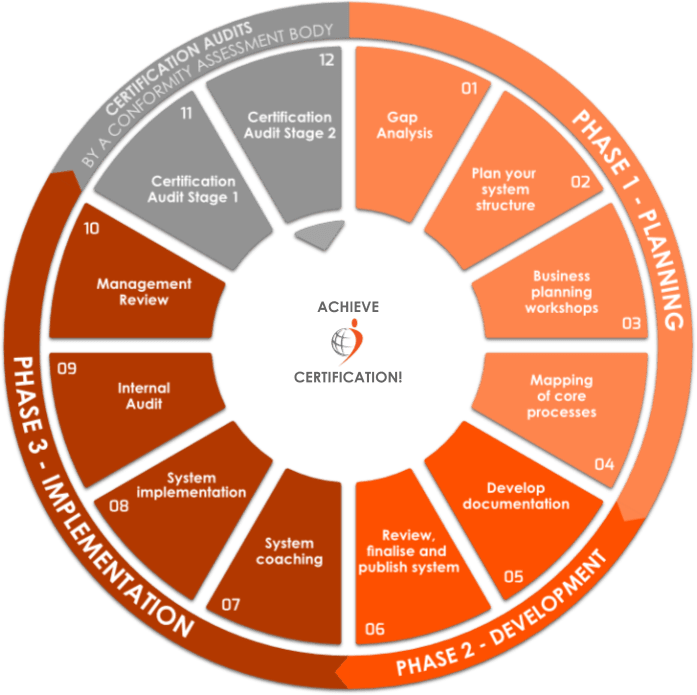
Get your FREE Certification Readiness Process Diagram today!
What Our Clients Have to Say
Discover how we’ve helped organisations like yours achieve their certification goals. Read our clients’ testimonials and Google reviews to learn about their experiences and the value we’ve delivered.


Why ISO 14001?
Achieving ISO 14001 Certification is highly beneficial for any size organisation seeking to improve their environmental performance as it provides an internationally recognised Environmental Management System (EMS) framework. The environmental standard offers a structured approach to sustainability, guiding organisations in aligning their operations with global environmental standards. This certification demonstrates a commitment to ethical practices while enabling businesses to navigate complex ecological challenges, thus ensuring a greener and more prosperous future.
By achieving this certification, organisations can also effectively manage and reduce their environmental impact, ensuring compliance with environmental regulations and fostering a positive reputation. It acts as a powerful business improvement tool, enabling organisations to enhance operational efficiency, reduce costs and waste, and optimise resource utilisation.
Additionally, Certification to ISO 14001:2026 can be a critical competitive advantage as it broadens your market opportunities with eligibility to secure bigger and better projects via government tenders and grants. The certification can also help organisations fulfil other contract or product requirements, and be used to help lower insurance premiums.
The Environmental Standard also helps organisations identify potential environmental risks and develop strategies to mitigate them, leading to better risk management and improved overall performance.
ISO 14001 Overview: Understanding the Key Requirements and Clauses
The ISO 14001:2026 Environmental Management System (EMS) Standard is divided into ten clauses, with Clauses 4 to 10 outlining the core requirements for building, implementing, maintaining, and improving an EMS. Below is a high level summary of the standard’s clauses and requirements.
Visit Standards Australia to acquire a licensed version of the ISO standard, to read the requirements of each clause in more detail.
How We Can Assist You
Our services are customisable for each business, depending on your specific needs.
Certification Readiness
Consulting services to assist your business in preparing for Certification by offering a personalised management system tailored to your specific business needs, meeting the requirements of the ISO 14001:2026 Standard. Our goal is to ensure that your business successfully obtains Certification the first-time.
Certification Ongoing Support
We provide support in fulfilling the ongoing requirements of your Environmental Management System and Certification, which includes managing your Internal Audit program and other yearly required activities to continually meet the ISO 14001:2026 Standard requirements.
Auditing
Our Internal Audit services facilitate continual improvement, while also ensuring that you are prepared for the External Certification Audit process, verifying that your Environmental Management System meets the requirements of the ISO 14001:2026 Standard. We also provide second party audit services.
ISO Gap Analysis
A Gap Analysis evaluates your current Management System against your target ISO standards to pinpoint exact gaps. It provides a clear roadmap to certification readiness, saving time and resources by focusing on what needs to be addressed.
Who Needs ISO 14001 Certification?
ISO 14001:2026 Standard is designed for organisations of all sizes and types that are committed to managing their environmental impact responsibly. Any organisation, regardless of whether it operates in the manufacturing, service, or public sector, can pursue ISO 14001 Management System and its certification.
The standard is particularly relevant to organisations seeking to enhance their environmental performance, mitigate environmental risks, and demonstrate their dedication to sustainability. Implementing ISO 14001 helps businesses establish an effective Environmental Management System (EMS) that identifies and controls the environmental aspects of their operations, products, and services.
This certification is valuable for companies looking to enhance their reputation among stakeholders, including customers, investors, regulators, and the local community.
We’ve helped over 200 client organisations achieve and maintain certification across a wide range of industries and sized organisations. Want to know if ISO 14001 is the right fit for your business? Book a FREE Strategy Session to discuss your needs.
ISO 14001 Standards Across Key Industries
At ISO Certification Experts, we bring deep experience across a wide range of industries, including manufacturing, healthcare, IT, construction, energy, and professional services. Our expert consultants deliver tailored solutions to guide your business throughout the entire certification process.
Explore below the main industries we’ve successfully supported with consulting services to ISO 14001:2026 Management System.
ISO 14001 for Manufacturing
Manufacturing workplaces often face environmental challenges such as waste management, energy consumption, and resource depletion. Implementing ISO 14001 helps address these issues by having in place effective waste reduction practices, energy efficiency policies, and sustainable resource management programs.
ISO 14001 for Construction
Companies in the construction industry must focus on mitigating environmental risks associated with energy consumption, pollution and waste generation. ISO 14001 helps mitigate these impacts by enforcing sustainable resource management practices, reducing energy usage, and ensuring compliance with environmental regulations.
ISO 14001 for Professional Services
While office environments are generally lower-risk, they still face environmental challenges such as waste management, energy consumption, and resource inefficiency. Certification of ISO 14001 helps companies implement effective recycling programs and ensure compliance with environmental regulations, contributing to a greener and more sustainable workplace.
ISO 14001 for Healthcare
In the healthcare sector, the ISO 14001 standard ensures compliance with environmental regulations related to hazardous materials and pharmaceuticals. This allows healthcare institutions to meet sustainability goals while reducing their operational costs and waste.
ISO 14001 for Retail & Wholesale
Retailers and wholesalers can leverage ISO 14001 to better manage supply chain sustainability and reduce waste produced from product packaging. They can also improve energy efficiency in stores and warehouses, lowering operational costs. ISO 14001:2026 encourages retailers to adopt eco-friendly sourcing practices and develop strategies to reduce their overall carbon footprint.
ISO 14001 for Hospitality & Tourism
Hotels, resorts, and tourism-related businesses can use ISO 14001 EMS to reduce their energy and water usage, manage waste more effectively, and improve their overall sustainability practices. This can result in cost savings and help position these businesses as eco-friendly destinations, appealing to environmentally conscious tourists.
History of ISO 14001
All ISO Standards are reviewed approximately every five years by ISO technical committees. If a standard is revised and updated as a result of this review, ISO will publish a new version of that Standard with the new title including with the year it was revised.
The initial version of ISO 14001 was made available in 1996 and has gone through various revisions over time. Below is a short summary of ISO 14001 standard over the years:
ISO 14001:1996
Withdrawn
ISO 14001 was first published in 1996, providing a framework for environmental management systems.
ISO 14001:2004
Withdrawn
The first revision of ISO 14001 clarified requirements and added new guidance on the evaluation of environmental performance.
ISO 14001:2015
Withdrawn
While ISO 14001:2015 is officially superseded, certified organisations have a three-year transition period to upgrade to the 2026 version.
ISO 14001:2026
Current Version
This current version was updated to better reflect modern sustainability challenges and digital integration.
Get a Free Initial Assessment of
your Organisation’s Certification
Readiness via the Form Below

Why Choose ISO Certification Experts for ISO 14001 Environmental Management
Since our founding in 2007, ISO Certification Experts has built a strong reputation with experience in helping organisations achieve and maintain Certification to ISO 14001. We bring together industry-leading expertise and a deep understanding of environmental management systems. Our proven success in guiding businesses through the complexities of ISO 14001 makes us a trusted partner for improving sustainability and reducing environmental impacts.
We collaborate with organisations of all sizes and industries, ensuring that they meet their environmental management objectives while enhancing efficiency, reducing costs, and staying compliant with global environmental standards. At ISO Certification Experts, we simplify the certification process, providing you with seamless support and expert guidance to help your business achieve long-term environmental sustainability.
Featured Case Studies and Real-World Success Stories
Read our client testimonials, featuring some of Australia’s most reputable companies showcasing how ISO Certification Experts have helped businesses achieve and maintain certification.


Some of Our Clients








Start Your Journey with ISO Certification Experts
Book a FREE Strategy Session with us to discuss the best approach for your business, understand the benefits for your organisation, and find out how we can best help you achieve your goals!
Frequently Asked Questions about ISO 14001
Have a question we didn’t answer here? Visit our full FAQ page.