ISO Standards Don’t Tell You How to Run Your Business (And Why That’s a Good Thing)
If you have ever sat down to read through an ISO standard requirements document, whether it’s ISO 9001 (Quality), ISO 14001 (Environment), ISO 45001 (Occupational Health & Safety), or ISO 27001 (Information Security), you have likely experienced a distinct moment of realisation: The document is filled with strict things your business must do, yet it is almost entirely devoid of instructions on how to actually do them.
This is the ultimate paradox of ISO Management System Standards. They dictate the destination, but they do not provide the map. They tell you what objectives your management system must achieve, but how you address those requirements is completely up to you. For an agile business, this structural flexibility is a massive benefit. It means you can interpret the requirements to fit your unique operational workflows, rather than forcing your team into a rigid, bureaucratic straightjacket.
For many business owners and operational managers, this open-ended nature presents a major headache. The lack of a prescriptive “how-to” guide breeds uncertainty, leaving teams paralysed by the question: “Are we actually meeting the requirement, or are we setting ourselves up to fail an audit?”. This is precisely why businesses partner with specialist consultants like our team at ISO Certification Experts. We bridge the gap between the abstract language of international management standards and the practical realities of your daily operations.
In this guide, we’ll unpack the design behind this flexibility, map out the standard core clauses, and explore practical examples of how different business types satisfy identical requirements in completely unique ways, across the following sections:
Why Are ISO Management System Standards Written This Way?
ISO standards are built to be universal. The exact same ISO 9001 standard must apply equally to a three-person consulting boutique in Melbourne, a mid-sized civil construction firm in Perth, and a multi-national pharmaceutical manufacturer in Sydney with thousands of moving parts.
If the International Organization for Standardization (ISO) dictated precise operational methods, the standards would immediately become useless for 99% of businesses. Instead, ISO outlines performance-based requirements. They focus heavily on outcomes rather than methods. This offers two major advantages:
The Real Challenge: Choice Paralysis
The challenge occurs because the standards rely on open-ended verbs like “determine,” “establish,” “implement,” and “maintain.” They demand an outcome but leave a blank canvas for the execution.
Without expert guidance, organisations often over-engineer their systems. They create mountains of unnecessary paperwork, redundant spreadsheets, and administrative bloat, slowing down the business just to “prove” conformance to an auditor. Our job as consultants is to show you that it doesn’t have to mean bureaucracy. You can satisfy the requirements of the standard(s) while keeping your workflows lean and profitable.
The 10-Clause Harmonised Structure
To understand how to address the requirements, you must first understand how modern ISO Management System Standards are organised. All major standards share a common framework called the Harmonised Structure. This similar core structure makes it significantly easier for businesses to build an Integrated Management System (IMS) that combines Quality, Health and Safety, Environmental and others into a single streamlined framework. The structure consists of ten clauses. The first three are introductory, while Clauses 4 through 10 contain the actual auditable requirements that your business must satisfy to achieve certification.
| Clause Number | Clause Name | Core Requirement | Strategic Business Action |
|---|---|---|---|
| Clause 4 | Context of the Organisation | Identify internal and external issues and interested parties. | Define your business boundaries and operating landscape. |
| Clause 5 | Leadership | Top management must demonstrate active commitment. | Align leadership, define policies, and assign clear roles and responsibilities. |
| Clause 6 | Planning | Identify risks, opportunities, and measurable objectives and targets. | Build a mindset of embarking on opportunities, preventing risks from eventuating, and map out measurable operational goals. |
| Clause 7 | Support | Provide resources, awareness and training across the team, and supporting documented information. | Equip your team with the tools, training, and systems they need. |
| Clause 8 | Operation | Plan, implement, and control operational processes. | Execute your core business operational processes under defined, controlled conditions. |
| Clause 9 | Performance Evaluation | Monitor, measure, analyse, and evaluate business performance. | Review your performance through internal audits and analyse your data via management reviews. |
| Clause 10 | Improvement | Address identified non-conformities and drive continual improvement. | Investigate systemic failures and continually optimise processes. |
Expert Tip
We recommend purchasing an officially licensed version of your intended ISO standard(s). In Australia, these can be purchased directly from Standards Australia or via the official ISO website. Beyond ensuring your team is working from the correct, most up-to-date version during implementation, it’s important to have access to this as a reference for the long term, when questions come up about future management system improvements.
Directly Mapping Requirements to Practice

Two businesses can look completely different on paper, yet both can be 100% conforming with the exact same ISO clause requirements.
Let’s look at three practical examples across different standards, directly mapping the clause requirement to how two completely different types of businesses might choose to address them.
Practical Example 1: Clause 6.1 (Actions to Address Risks and Opportunities)
The Requirement: The standard states that the organisation must determine risks and opportunities to ensure the management system can achieve its intended outcomes, prevent undesired effects, and achieve continual improvement.
For example, a small consulting firm that operates primarily from a corporate office won’t have as many severe operational hazards as a medium-sized construction company that deals with high-risk environments daily. Therefore, the way they manage their risks could look completely different.
Practical Example 2: Clause 7.2 (Competence)
The Requirement: The organization must determine the necessary competence of the person(s) doing work under its control that affects its performance, ensure these persons are competent based on appropriate education, training, or experience, and retain documented information as evidence.
Satisfying this requirement depends heavily on, for example, whether your workforce is managing professional files or heavy machinery.
Practical Example 3: Clause 6.2 (Objectives and Planning to Achieve Them)
The following table provides a clear, side-by-side comparison to help your team understand the two processes at a glance.
The Requirement: The organisation must establish measurable management system objectives at relevant functions and levels, and define clear plans to achieve them, including what will be done, what resources are required, who is responsible, when it will be completed, and how results will be evaluated.
The Strategic Pathway to ISO Certification
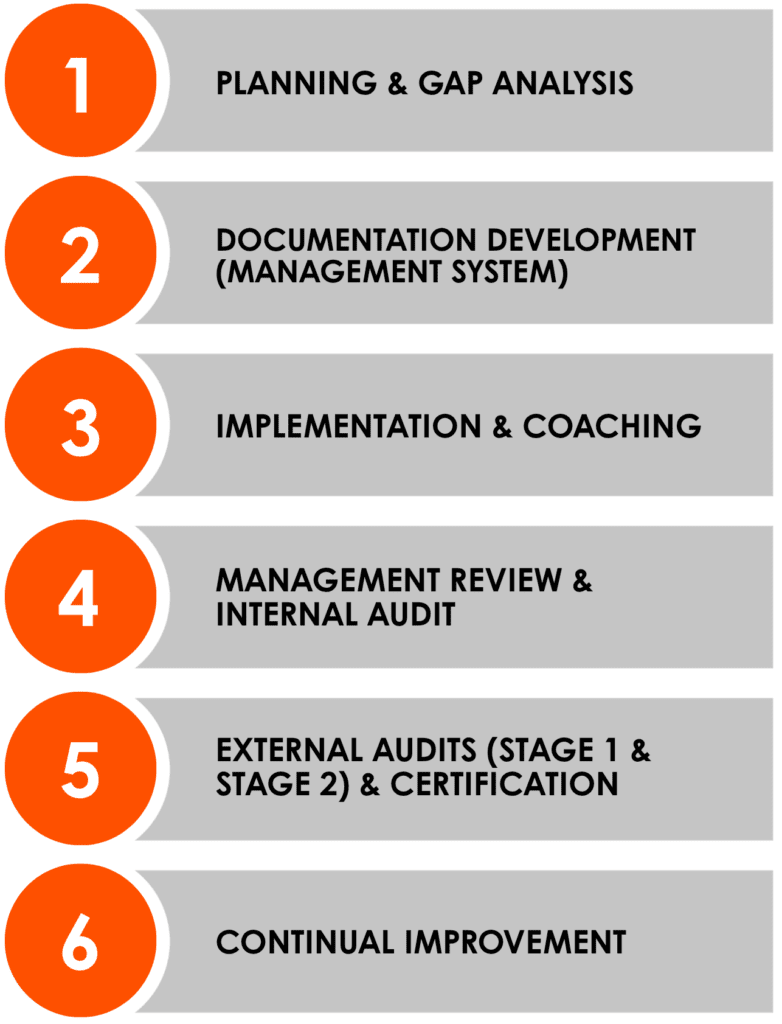
When you decide to achieve certification, knowing how to upgrade your business for certification-readiness is only half the battle. You also need a clear, structured roadmap to navigate the process smoothly without disrupting your business.
1. Planning & Gap Analysis
Understanding the baseline requirements of your chosen ISO standard is crucial. Planning involves conducting a Gap Analysis to evaluate your organisation’s current operational processes against the ISO requirements. A customised plan is then developed to address these gaps, establishing a clear, efficient strategic roadmap for the certification process rather than starting from scratch.
2. Management System Documentation Development
A set of documented information needs to be developed to support the operational processes – think of it like an instruction book for how to run the business. This generally includes a business planning framework, policies, process maps, procedures, work instructions, updated position descriptions, templates to capture data and more.
This stage is where expertise in applying clause requirements matters most; handling this step strategically saves massive amounts of time and prevents future administrative bloat.
3. Implementation & Coaching
The newly designed management system should have been reverse-engineered to match (and in some areas improve) current practice. Employees are guided through targeted coaching to fully understand the updated documentation, as well as any changing roles and responsibilities. Successful implementation means consistently applying these documented processes in daily operations, monitoring activities for conformance, and gathering data to measure performance.
4. Management Review & Internal Audit
Before going for certification, two critical review mechanisms are required by the standards. First, an impartial Internal Audit evaluates how effectively your management system conforms to the standard requirements and identifies areas needing correction. Second, a Management Review process, where top leadership assesses performance data and overall effectiveness, ensuring the system is suitable, adequate, and supporting the strategic business goals.
5. External Audits & Certification
At this stage, you engage a JASANZ accredited Certification Body (Conformity Assessment Body). Independent external auditors will conduct the official Certification Audits to assess your management system against the standard requirements. They evaluate the system’s operational effectiveness, and look for real-world evidence of conformance to ensure the requirements of the standard(s) are being met. Upon successful completion of this external assessment, your organisation officially receives its ISO Certification.
6. Continual Improvement
Once your ISO Certification is achieved, it is valid for three years, during which time your Certification Body will return to conduct annual surveillance audits to ensure your business maintains its conformance. Ongoing systemic activities are required by your organisation to ensure your system continues to satisfy the standard(s), driving operational efficiency, lowering risks, and fostering sustainable business growth over time.
How ISO Certification Experts Take the Confusion Out of the Process
It is precisely because ISO standards give you total freedom, that they can feel so incredibly overwhelming. When everything is left up to interpretation, it is easy to over-complicate processes, waste resources on bloated administration, or completely miss a minor clause requirement that ends up causing a major non-conformance during your certification audit.
That is where we come in. At ISO Certification Experts, we don’t believe in generic templates or forcing your business to adopt a rigid, pre-written system designed only to pass an audit. Our approach focuses entirely on your business. We take the confusion out of the standards, translating complex ISO clause requirements into practical, everyday business workflows.
Here is why businesses trust us:
Stop guessing how to address the requirements of ISO 9001, 14001, 45001 or ISO 27001. Let us build a bespoke management system that streamlines your operations, wins more tenders, and helps your business grow.
Book your Free Strategy Session with ISO Certification Experts today and discover how easy ISO certification can be when you have the right team by your side.
About the author

Sarah is a seasoned Business Development Manager at ISO Certification Experts, specialising in providing tailored certification solutions for ISO 9001, ISO 14001, ISO 45001, and ISO 27001 to our clients. In addition to her strong background in quality management systems, Sarah also has a proven track record of driving revenue growth and building strategic partnerships, while her collaborative approach fosters a culture of continuous improvement. Dedicated to delivering exceptional customer service, she helps organisations with the right solutions to their certification needs.
- Sarah Kammigan

- Sarah Kammigan

- Sarah Kammigan

- Sarah Kammigan

- Sarah Kammigan

- Sarah Kammigan

- Sarah Kammigan

- Sarah Kammigan

- Sarah Kammigan

- Sarah Kammigan

- Sarah Kammigan

- Sarah Kammigan

All information on this blog site is for informational purposes only. As this information is based on our professional experience, opinion, and knowledge, we make no representations as to the suitability of this information for your individual business circumstances. Especiality Pty Ltd trading as ISO Certification Experts and all related businesses and brands will not be liable for any errors, omissions, legal disputes or any damage arising from its display or use. All information is provided as is, with no warranties and confers no rights.
We will not be responsible for any material that is found at the end of links that we may post on this blog site. The advice, ideas, and strategies should never be used without first assessing your own personal business situation or seeking professional and/or legal advice. Information may also change from time to time to suit industry and business needs, requirements and trends.