Integrating ISO 42001 with ISO 27001: Bridging Information Security and AI Governance
Whether integrating third-party large language models (LLMs) into SaaS workflows, deploying predictive algorithms in financial services, or developing proprietary machine learning models, organisations face mounting stakeholder demand for responsible, secure, and ethical AI usage and deployment.
Enter ISO/IEC 42001:2023, the world’s first certifiable standard for an Artificial Intelligence Management System (AIMS). For business leaders and risk managers, introducing another governance framework can feel daunting. However, if your organisation is already certified to ISO/IEC 27001:2022 (Information Security Management Systems – ISMS), you hold a substantial head start.
Both standards share the ISO Harmonised Structure, so achieving ISO 42001 certification is not a ground-up rebuild. It is an organic extension of the controls, policies, and management rhythms your team operates every single day.
What is ISO/IEC 42001?
ISO/IEC 42001:2023 specifies the requirements for establishing, implementing, maintaining, and continually improving an Artificial Intelligence Management System. Rather than evaluating the performance of a specific machine learning algorithm, it establishes an auditable organisational framework that addresses:
In essence, while ISO 27001:2022 protects data and technical assets from compromise, ISO 42001 governs the specific risks and decisions generated by AI systems acting on that data.
Why Build an Integrated Management System (IMS) for ISO 27001 & ISO 42001?
Managing multiple ISO standards independently has historically been a source of audit fatigue, redundant paperwork, and operational fragmentation. When you approach these two frameworks collaboratively, however, you create an Integrated Management System (IMS). An IMS does not run parallel systems but it merges them, streamlining conformance under a unified governance umbrella.
By integrating ISO 42001 with your existing ISO 27001:2022 setup, your business unlocks significant operational and strategic advantages:
By shifting from a siloed conformance mindset to an integrated perspective, you effectively convert two complex projects into one streamlined operational strategy.
Expert Tip
The beauty of this integrated model is that it isn’t limited to ISO 27001 and ISO 42001. The Harmonised Structure is across all modern ISO management system standards, so this same integration methodology applies seamlessly if your organisation also holds certification to, or is pursuing, ISO 9001 (Quality), ISO 14001 (Environmental), or ISO 45001 (Occupational Health & Safety).
The Shared Foundation: Understanding the Harmonised Structure
The most significant efficiency factor when integrating these two standards is their shared DNA. Both ISO 27001 and ISO 42001 follow ISO’s Harmonised Structure, comprising core Clauses 4 through 10:
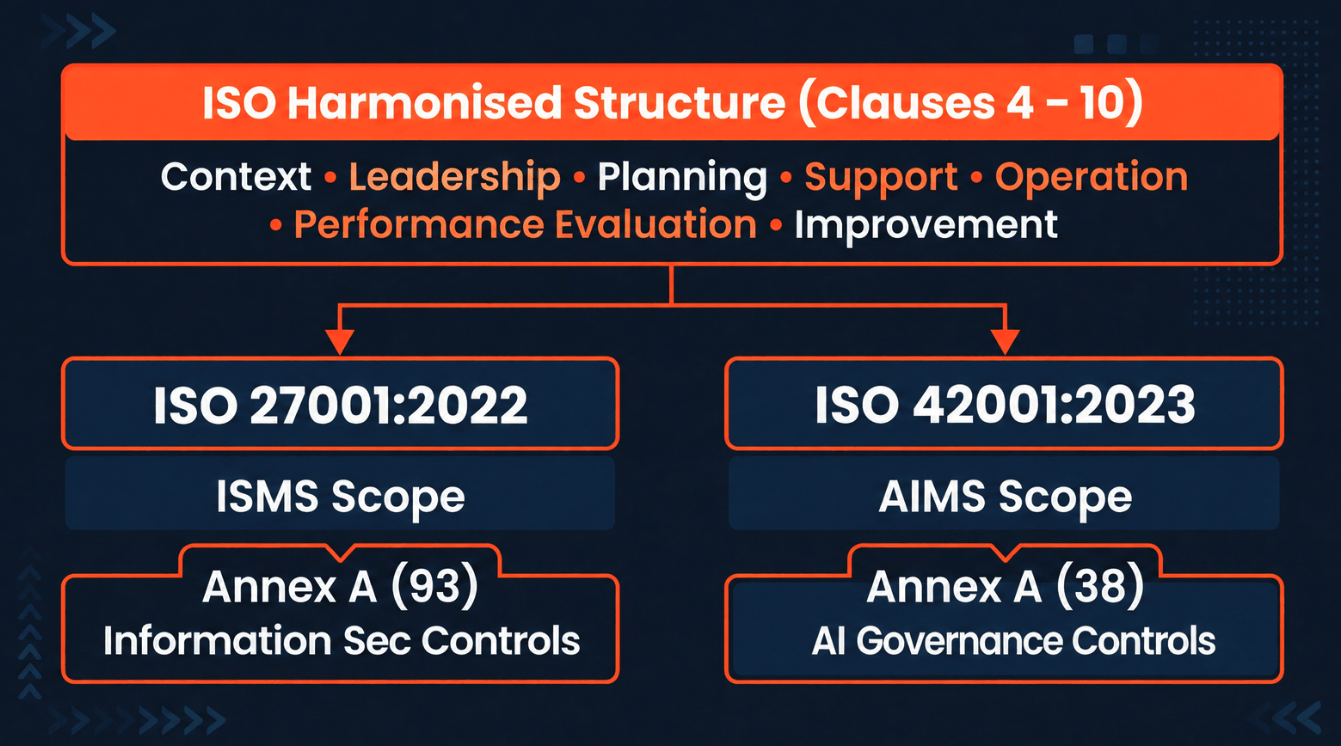
When your organisation already has an ISO 27001 management system in place, your leadership and compliance teams already maintain the foundation required by Clauses 4 through 10, and extending your scope to AI eliminates systemic redundancy.
Clause-by-Clause: Where ISO 27001 and ISO 42001 Overlap
Integrating an AIMS into an existing ISMS streamlines documentation, reduces stakeholder fatigue, and lowers total ongoing costs of maintaining multiple certifications. Here is how the core clauses map together.
Comparing the Controls: Annex A Mappings
While the high-level clauses align naturally, each standard delivers distinct domain controls through its normative Annex A.
| Aspect | ISO/IEC 27001:2022 | ISO/IEC 42001:2023 |
|---|---|---|
| Primary Focus | Confidentiality, Integrity, and Availability of Information | Ethical, Safe, and Trustworthy Use of AI Systems |
| Control Framework | 93 controls organised into 4 themes (Organisational, People, Physical, Technological) | 38 reference controls across 9 domains (A.2 to A.10) |
| Statement of Applicability (SoA) | Evaluates 93 controls | Evaluates 38 controls |
| Impact Focus | Internal business continuity, and data loss/exposure | External impact on individuals, stakeholders, and society |
| Data Governance | Data protection, encryption, and access control | Data provenance, representative training data, and data poisoning prevention |
5 Practical Steps to Integrate ISO 42001 into Your ISMS
To add ISO 42001 to an existing ISO 27001:2022 setup efficiently, follow this practical roadmap:
Step 1: Catalog AI Assets and Determine Roles
Map every instance of AI deployed or developed within your business, from customer-facing algorithms to internal productivity tools (e.g., automated coding copilots or customer service chatbots). For each system, document your role: are you a developer, provider, or deployer/user?
Step 2: Conduct an ISO 42001 Gap Analysis
Evaluate your current AI posture against the 38 controls of ISO 42001 Annex A. Pinpoint gaps specifically relating to algorithmic transparency, bias mitigation, explainability, and training data provenance.
Step 3: Implement the AI System Impact Assessment Framework
Establish a repeatable mechanism for assessing AI systems based on their potential consequences for human agency, discrimination, safety, and privacy. This is the core procedural addition to your current risk management workflow.
Step 4: Update and Develop Documentation
Revise your risk treatment plans and policy headers to reference both standards seamlessly.
Update existing process and policy documents that meet ISO 27001 clause and control requirements to account for clauses and controls in ISO 42001, and develop additional ISO 42001 processes for Annex A controls that do not overlap with ISO 27001.
Step 5: Conduct an Integrated Internal Audit
Before bringing in your accredited certification body, conduct a combined internal audit. Review joint operational controls simultaneously to confirm that the combined management system operates smoothly.
ISO 42001 Integration Benefits for ISO 27001 Certified Organisations
Pursuing ISO 42001 through an integration with an existing ISO 27001 certified management system yields measurable commercial advantages:
Achieving ISO 42001 certification doesn’t require your team to reinvent operational governance. If your organisation has already laid the groundwork with ISO 27001, the most complex systems (risk management structures, leadership charters, change controls, and audit rhythms) are already operating within your business.
If you’re ready to evaluate where your current controls overlap with ISO 42001, reach out to our team today to schedule an integrated gap assessment and fast-track your path to certification.
About the author

Anthony is the Consulting Manager at ISO Certification Experts, leading the team of consultants to deliver management system projects across Australia and internationally. Holding Master’s degrees in Strategy & Management and Project Management from UNSW, he is a certified implementer and auditor across ISO 9001, ISO 14001, ISO 45001, ISO 27001, and ISO 42001. With decades of experience, Anthony helps organisations achieve certification and drive continuous improvement.
- Anthony Pool

- Anthony Pool

- Anthony Pool

- Anthony Pool

All information on this blog site is for informational purposes only. As this information is based on our professional experience, opinion, and knowledge, we make no representations as to the suitability of this information for your individual business circumstances. Especiality Pty Ltd trading as ISO Certification Experts and all related businesses and brands will not be liable for any errors, omissions, legal disputes or any damage arising from its display or use. All information is provided as is, with no warranties and confers no rights.
We will not be responsible for any material that is found at the end of links that we may post on this blog site. The advice, ideas, and strategies should never be used without first assessing your own personal business situation or seeking professional and/or legal advice. Information may also change from time to time to suit industry and business needs, requirements and trends.